
Mimosa hostilis root bark powder
Price range: $180.00 through $900.00
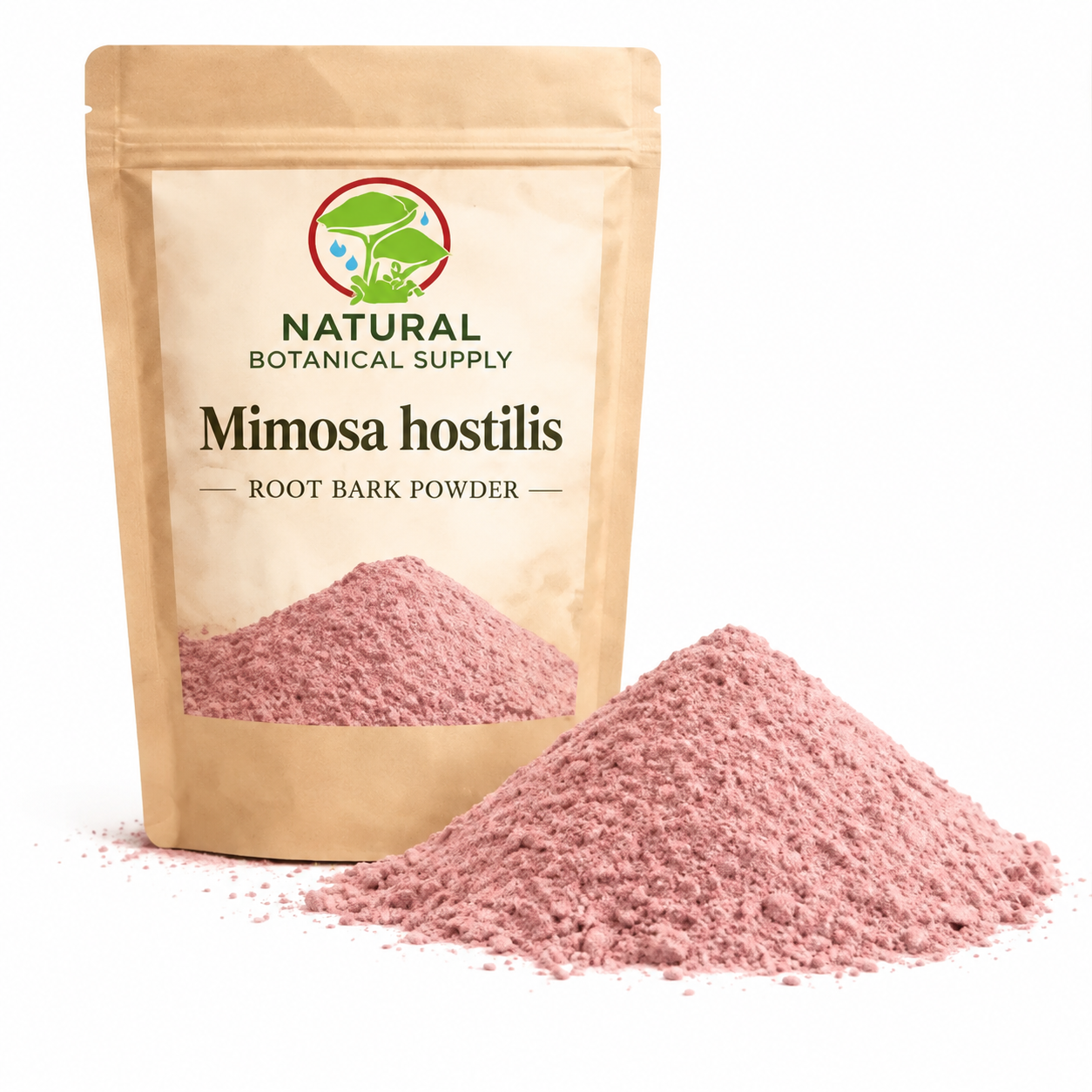
🌿 Mimosa Hostilis Root Bark Powder (MHRB) — finely milled inner root bark from cultivated Mimosa tenuiflora trees.
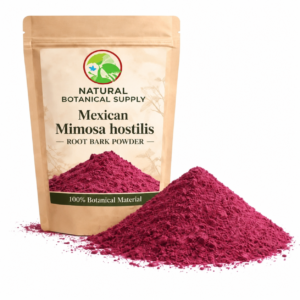
Deep reddish-brown color, uniform texture, and clean earthy aroma. Supplied as a botanical specimen for natural dye work, herbarium collections, and ethnobotanical reference.
🌱 Cultivated sourcing · Origin-labeled · Additive-free · Not for consumption.
🌿 Mimosa Hostilis Root Bark Powder (MHRB) — Botanical Specimen
Mimosa tenuiflora — commonly known as Mimosa Hostilis, Jurema Preta, or Tepezcohuite — is a leguminous tree native to northeastern Brazil and parts of Mexico. Its inner root bark has been documented in ethnobotanical literature for centuries and is valued today for natural dye work, botanical study, and traditional craft applications.
Our Mimosa Hostilis Root Bark Powder is produced from the dried inner root bark of cultivated Mimosa tenuiflora trees. The bark is carefully separated, dried, and finely milled to a uniform powder that preserves the material’s natural deep reddish-brown color and characteristic botanical properties.
📋 Botanical Profile
| Attribute | Detail |
|---|---|
| Scientific name | Mimosa tenuiflora (syn. Mimosa hostilis) |
| Common names | Mimosa Hostilis, Jurema Preta, Tepezcohuite, Cabrera |
| Family | Fabaceae (Leguminosae) |
| Genus | Mimosa |
| Plant type | Perennial tree or shrub |
| Typical height | 4–8 meters at maturity |
| Native range | Northeastern Brazil, Mexico, northern South America |
| Plant part | Inner root bark |
| Form supplied | Finely milled powder |
| Processing | Dried and ground only — no chemical treatment |
Scientific classification and synonym history are documented in the Royal Botanic Gardens Kew Plants of the World Online database.
🌎 Origin & Growth Characteristics
Mimosa tenuiflora grows naturally in the semi-arid caatinga biome of northeastern Brazil and in the warmer, drier regions of Mexico. It is a hardy, drought-tolerant species that thrives in poor, rocky soils where few other trees survive.
The tree typically grows as a thorny shrub or small tree reaching 4–8 meters in height. Its most recognizable features are its finely divided fern-like leaves and its dense, spiny branches. In late spring and early summer it produces small clusters of white flowers.
Because it grows in two distinct regions — northeastern Brazil and Mexico — the material is often characterized by origin. Brazilian bark typically has a deeper, more burgundy-red tone and thicker fibers. Mexican bark tends to be lighter in color and more uniform in texture. Both are high quality; the differences reflect growing environment rather than product superiority.
📖 Why Mimosa Hostilis Root Bark Is Valued
Mimosa Hostilis Root Bark has drawn steady interest across multiple fields — natural dye chemistry, botanical research, and ethnobotanical documentation. Its relevance comes from several factors.
Natural Dye Applications
One of the most established uses of MHRB is as a source of natural dye. The inner bark produces warm reddish-brown to deep burgundy tones on textiles, particularly on natural fibers like cotton, wool, and linen. Dye practitioners value it for the depth and durability of the color it produces, both on its own and as part of a mordant-assisted dye bath.
Botanical Study & Collection
Because Mimosa tenuiflora is a distinctive leguminous species with a well-documented range, accurately labeled specimens support herbarium work, comparative taxonomy, and educational study of tropical Fabaceae plants.
Ethnobotanical Reference
The species has a long documented history in the cultural practices of Indigenous communities across Brazil and Mexico. Well-labeled botanical specimens support documentation and study of traditional plant knowledge.
✨ Common Applications
- Natural dye work — produces warm reddish-brown to burgundy tones on natural fibers
- Herbarium & botanical collections — uniform powder for reference archives and comparative study
- Ethnobotanical documentation — labeled specimens support cultural and botanical research
- Botanical education — useful for teaching tropical Fabaceae and traditional dye plant studies
- Craft applications — plant-based pigments, botanical inks, and traditional artisan work
🔬 Powder vs Shredded vs Whole Form
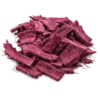
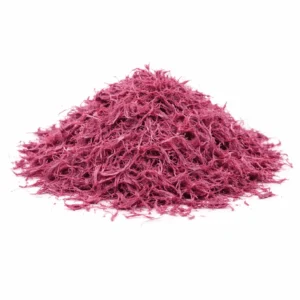
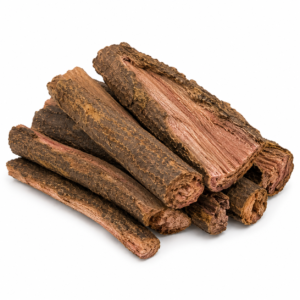
We supply Mimosa Hostilis Root Bark in three forms. Powder — the format on this page — is finely milled inner root bark with the highest surface area. It is best for dye baths, precise measurement, and applications where consistency matters. Shredded bark is cut into small uniform pieces that retain visible plant structure, easier to handle and better for long storage. Whole bark is minimally processed and retains the largest pieces, preferred for specimen collections and buyers who want to process material themselves.
All three forms come from the same inner root bark of cultivated Mimosa tenuiflora trees.
🌱 Quality Characteristics
Our Mimosa Hostilis Root Bark Powder is:
- Sourced from cultivated Mimosa tenuiflora trees — not wild-harvested
- Made from inner root bark only — no outer bark contamination
- Carefully dried and finely milled to uniform particle size
- Free from additives, fillers, or chemical treatments
- Labeled with botanical name, origin, and lot number for traceability
- Inspected for color consistency, moisture content, and absence of contamination
High-quality MHRB powder typically shows a deep, consistent reddish-brown to burgundy tone, a fine uniform texture, and a clean, earthy botanical aroma. Pale, washed-out, or clumping material usually indicates outer bark contamination, poor processing, or moisture exposure.
📦 Storage Guidance
To preserve quality over time:
- Store in an airtight container away from direct sunlight and heat
- Keep in a cool, dark, dry location
- Add a food-grade silica gel desiccant packet for extended storage
- Handle with clean, dry hands or tools to avoid transferring moisture
- Label with the date received to track storage duration
Properly stored, Mimosa Hostilis Root Bark Powder retains its color, texture, and botanical integrity for roughly 12 months. Powder degrades faster than whole or shredded bark because of its greater surface area. For general dried specimen storage guidance, see the Kew Herbarium collection guidelines.
📏 Available Quantities
Available in 1 kg, 2 kg, 3 kg, 4 kg, and 5 kg quantities. Bulk pricing available on request for larger orders. We also carry shredded and whole forms if you prefer a less processed format.
⚠️ Compliance Notice
Mimosa Hostilis Root Bark Powder (Mimosa tenuiflora) is sold strictly as a botanical specimen for herbarium collection, botanical education, natural dye work, and ethnobotanical reference purposes only.
It is not intended for human consumption, extraction, or any application prohibited by law. The seller makes no claims regarding medicinal, therapeutic, or psychoactive properties of this material. Buyers are solely responsible for verifying that purchasing, importing, and possessing this plant material is lawful in their jurisdiction before placing an order.
❓ Frequently Asked Questions
What is Mimosa Hostilis Root Bark Powder?
Mimosa Hostilis Root Bark Powder (MHRB) is finely milled inner root bark from Mimosa tenuiflora, a leguminous tree native to Brazil and Mexico. It is supplied as a botanical specimen for dye work, herbarium collections, and ethnobotanical reference.
Is Mimosa Hostilis the same as Mimosa tenuiflora?
Yes. Mimosa Hostilis is the older and more widely used common name; Mimosa tenuiflora is the currently accepted scientific classification. They refer to the same species.
What does MHRB stand for?
MHRB is an abbreviation for Mimosa Hostilis Root Bark — the dried inner bark of the roots of the Mimosa tenuiflora tree.
Is this powder made from inner root bark or whole bark?
Our MHRB powder is made from inner root bark only. The outer bark is removed before processing to ensure a cleaner, more uniform product with consistent color and texture.
What is the difference between powder, shredded, and whole MHRB?
Powder is finely milled with the highest surface area, best for dye baths and precise measurement. Shredded bark is cut into small fibrous pieces that are easier to handle and better for storage. Whole bark is the least processed form, best for specimen collections and buyers who prefer to process material themselves.
Does Mimosa Hostilis Root Bark work as a natural dye?
Yes. The inner root bark produces warm reddish-brown to deep burgundy tones on natural fibers like cotton, wool, and linen. It works both on its own and with mordants such as alum or iron.
Where does your Mimosa Hostilis come from?
Our MHRB is sourced from cultivated Mimosa tenuiflora trees. Each batch is labeled with origin and a lot number for traceability.
How should I store Mimosa Hostilis Root Bark Powder?
Store in a sealed, airtight container in a cool, dark, dry location away from direct sunlight. Add a silica gel desiccant packet for extended storage. Properly stored, the powder retains quality for roughly 12 months.
Is Mimosa Hostilis legal to buy?
Legality varies by jurisdiction. Buyers are responsible for verifying that purchasing, importing, and possessing this plant material is lawful in their location before placing an order.
| Quantity | 1kg, 2kg, 3kg, 4kg, 5kg |
|---|
Be the first to review “Mimosa hostilis root bark powder”
Related products

Mimosa Hostilis Root Bark
Mimosa Hostilis Root Bark

Mimosa Hostilis Root Bark
Mimosa Hostilis Root Bark

Mimosa Hostilis Root Bark

Mimosa Hostilis Root Bark
Mimosa Hostilis Root Bark
Mimosa Hostilis Root Bark
Reviews
There are no reviews yet.