Blog
Mimosa Hostilis Root Bark: Complete Botanical Guide
Sep
Mimosa Hostilis Root Bark: Complete Botanical Guide
A beginner-friendly reference covering botany, origin, forms, quality markers, and storage — written for researchers, artisans, and natural material enthusiasts.
Introduction
If you’ve come across the term Mimosa Hostilis Root Bark — often abbreviated as MHRB — while researching natural dyes, botanical ingredients, or plant-based craft materials, you’re in good company. This plant material has drawn steady attention from researchers, soapmakers, natural dye practitioners, artisans, and botanical collectors across the world.
But what exactly is Mimosa Hostilis Root Bark, and why does it keep appearing in conversations about traditional plant materials?
This guide is written as a starting point. It covers what the plant actually is, where it grows, how root bark differs from other parts of a tree, the forms it’s sold in, and how to tell a good batch from a poor one. Whether you’re new to working with botanical materials or simply trying to understand the vocabulary you keep seeing, this is the reference we wish existed when we started sourcing.
What Is Mimosa Hostilis?
Mimosa Hostilis is the common trade name for the plant species scientifically classified as Mimosa tenuiflora. It is a perennial tree or shrub in the legume family (Fabaceae, formerly Leguminosae) and is native to regions of Latin America — primarily northeastern Brazil and parts of Mexico, with additional populations across northern South America.
The plant has been documented in ethnobotanical literature for centuries and continues to be studied today for its botanical, chemical, and cultural significance. Despite the name, it is not the same species as the ornamental “mimosa” trees commonly planted in temperate gardens — those belong to entirely different genera. Mimosa Hostilis is a distinct tropical species with its own characteristics.
Key Botanical Facts
| Attribute | Detail |
|---|---|
| Scientific name | Mimosa tenuiflora (syn. Mimosa hostilis) |
| Family | Fabaceae (Leguminosae) |
| Common names | Mimosa Hostilis, Jurema Preta, Tepezcohuite, Cabrera |
| Plant type | Perennial tree or shrub |
| Typical height | 4–8 meters at maturity |
| Native range | Northeastern Brazil, Mexico, northern South America |
| Climate | Tropical and semi-arid; highly drought-tolerant |
| Soil preference | Poor, rocky, sandy, well-drained soils |
| Leaves | Finely pinnate, fern-like compound leaves |
| Flowers | Small white clustered inflorescences |
| Growth habit | Thorny branches; evergreen in most climates |
What the Plant Looks Like
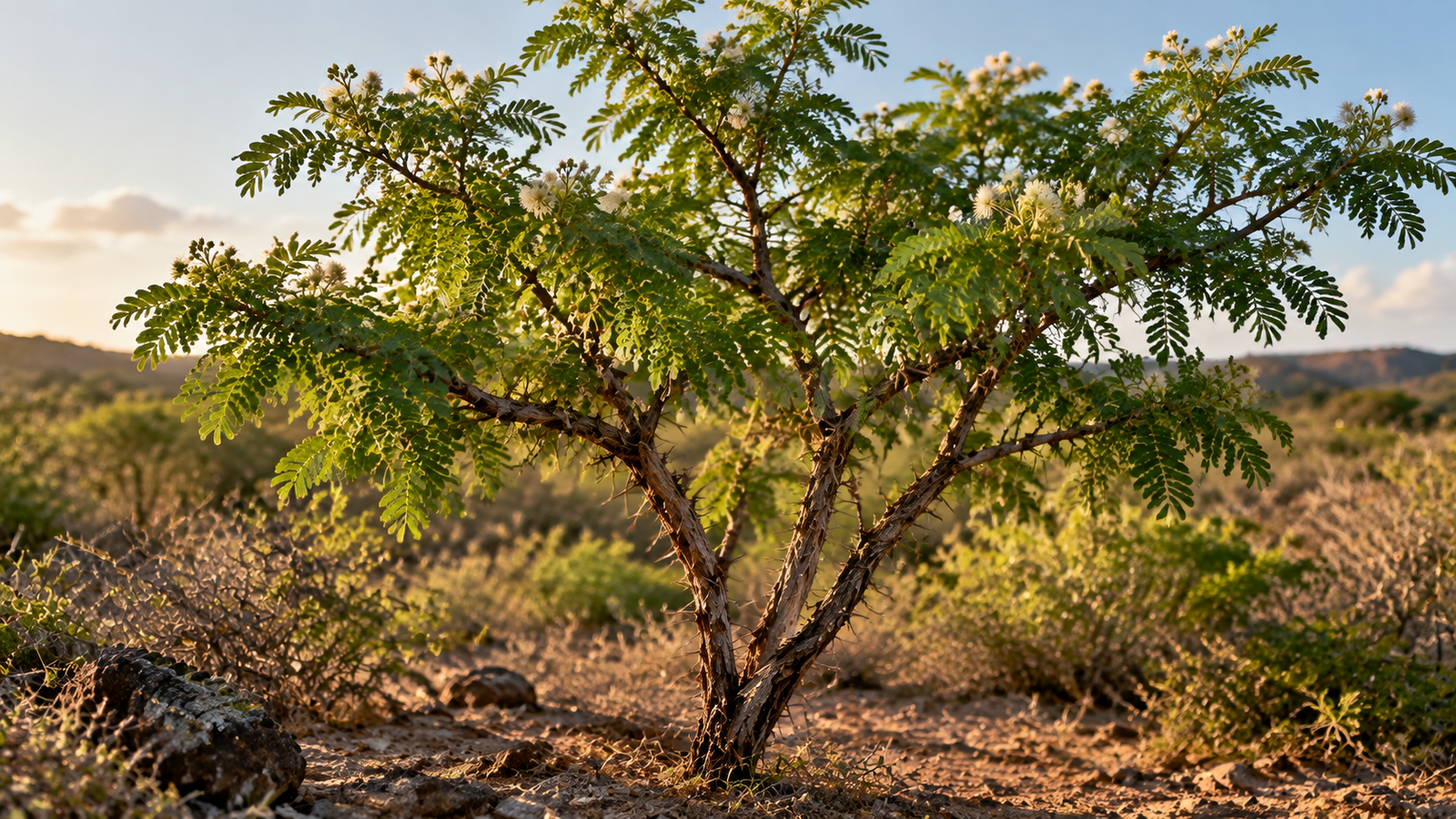
Mimosa Hostilis typically grows as a thorny shrub or small tree, reaching 4 to 8 meters in height under favorable conditions. Its most recognizable features are its finely divided, fern-like leaves and its dense, spiny branches. In late spring and early summer it produces small, clustered white flowers.
The plant is remarkably resilient — it tolerates drought, poor soil, and disturbance, which is partly why it has spread so widely across tropical and semi-arid regions of the Americas.
The tree is known by different regional names. In Brazil it is most commonly called Jurema Preta (“black jurema”). In Mexico it is known as Tepezcohuite. In academic and commercial contexts, Mimosa Hostilis and its abbreviation MHRB (for Mimosa Hostilis Root Bark) are the standard terms.
What Is Root Bark?
Before going further, it’s worth being precise about terminology — because root bark is not the same thing as trunk bark, branch bark, or the plant’s leaves, and the difference matters.
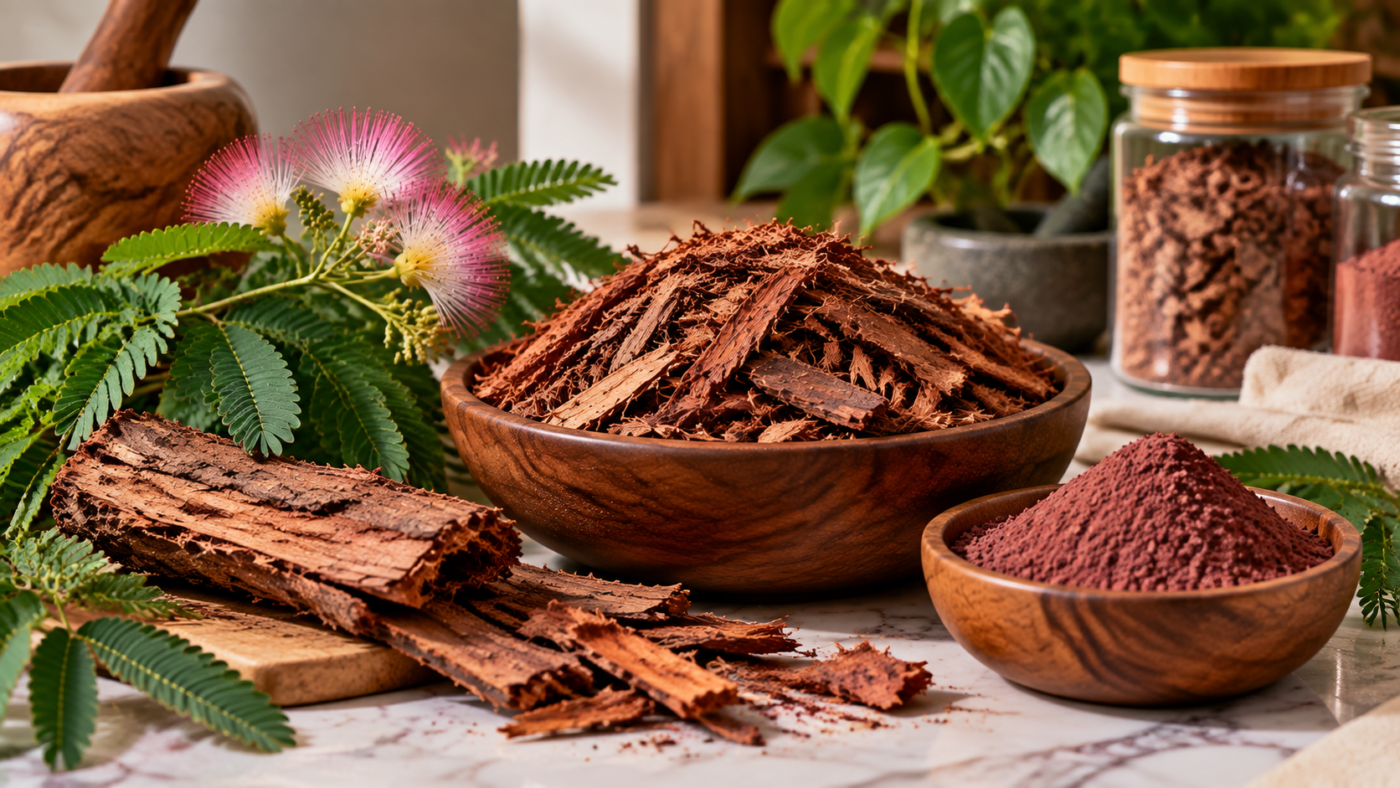
A tree’s root system consists of a woody inner core surrounded by a protective outer layer. That outer layer is the root bark. It is typically peeled away from the root wood and dried before use. Root bark is biochemically distinct from bark taken from other parts of the tree: it tends to contain higher concentrations of tannins, natural pigments, and other phytochemicals the plant produces as part of its root defense system.
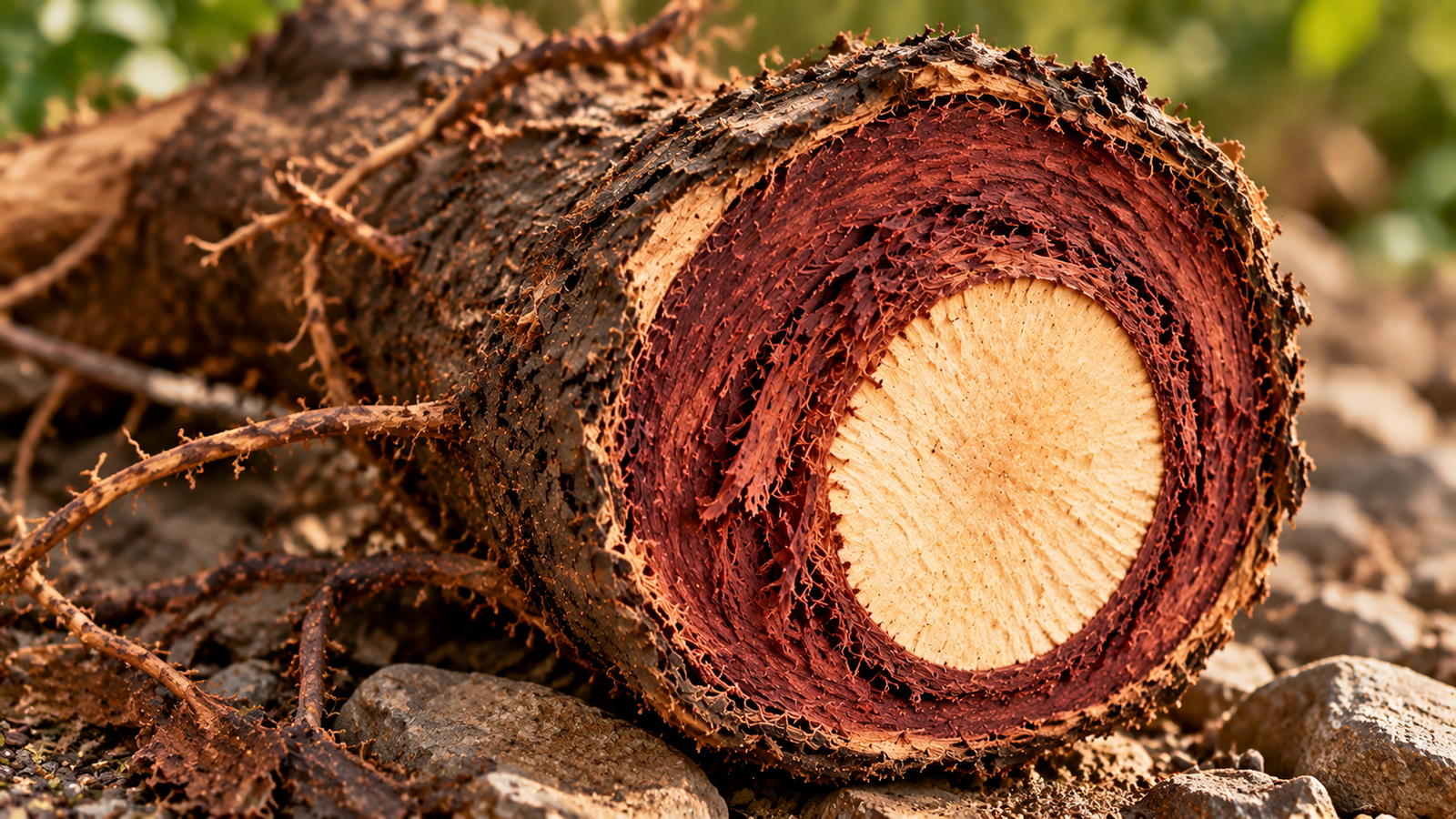
Within the root bark itself, there is a further distinction:
- Outer bark — the rough, dark outermost layer that protects the root from soil, moisture, and microorganisms
- Inner bark — the fibrous, deeply colored layer just beneath the outer surface. This is the material most valued in botanical trade and is what the term MHRB almost always refers to
When you see Mimosa Hostilis Root Bark or MHRB listed for sale, the product is nearly always the dried inner root bark. Outer bark is usually removed during processing because it contains little of the material researchers and artisans are looking for.
Where Does Mimosa Hostilis Grow?
Mimosa Hostilis is native to tropical and semi-arid regions of Latin America. Two source regions dominate the commercial supply:
Brazil (Jurema Preta)
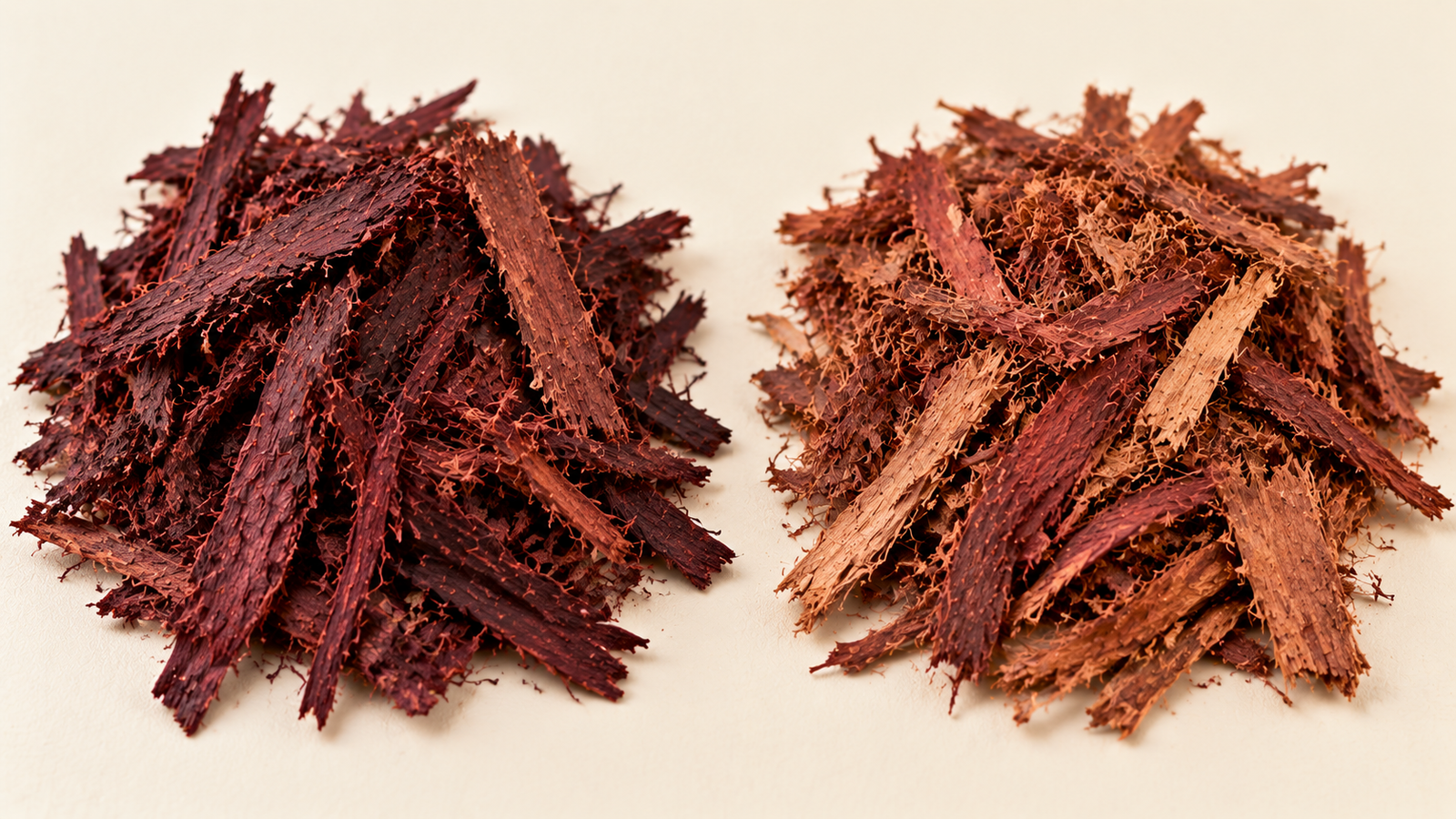
Brazilian Mimosa Hostilis — known locally as Jurema Preta — grows primarily in the northeastern states, an area characterized by the caatinga biome: dry, thorny scrubland with seasonal rainfall and poor, rocky soil. Brazilian material typically has a thicker, more fibrous root bark with a deeper, more burgundy-toned coloration.
Mexico (Tepezcohuite)
Mexican Mimosa Hostilis — Tepezcohuite — grows in the warmer, drier regions of southern and central Mexico. Mexican root bark tends to be somewhat lighter in color and more uniform in texture than Brazilian material, with slightly thinner bark layers. For many craft and dye applications, buyers prefer Mexican material for its consistency.
Both regions produce high-quality material. The difference is largely one of character rather than quality — similar to how coffee from different regions has its own distinct profile. Reputable suppliers label the origin clearly so buyers can choose based on their specific needs.
Why Is Mimosa Hostilis Root Bark Studied?
Mimosa Hostilis Root Bark has attracted interest across multiple fields — ethnobotany, natural dye chemistry, materials science, and traditional plant studies. Its significance comes from several overlapping factors.
Rich Phytochemical Profile
Like many leguminous plants, Mimosa Hostilis produces a complex array of secondary metabolites — compounds the plant generates for its own defense and survival. Root bark contains notable concentrations of:
- Tannins — polyphenolic compounds that bind to proteins and are widely used in traditional tanning and dyeing
- Flavonoids — plant pigments with antioxidant properties widely studied in botanical chemistry
- Saponins — natural surfactants found in many legume species
- Natural pigments — the deep red-brown coloration that makes the root bark valuable for dye applications
Natural Dye Applications
One of the most established uses of Mimosa Hostilis Root Bark is as a source of natural dye. The inner bark produces warm reddish-brown to deep burgundy tones on textiles, particularly on natural fibers like cotton, wool, and linen. Dye practitioners value it for the depth and durability of the color it produces.
Ethnobotanical Documentation
Mimosa Hostilis has a long documented history in the cultural practices of Indigenous communities in Brazil and Mexico. Researchers studying traditional plant knowledge and pre-colonial botanical use frequently reference the species. Well-documented, accurately labeled botanical specimens support this kind of study.
Craft and Artisanal Applications
Beyond dye work, the material appears in natural craft projects — botanical inks, plant-based pigments, and traditional artisan applications. Its stable color and fibrous texture make it a practical choice for makers working with natural materials.
Common Forms of Mimosa Hostilis Root Bark
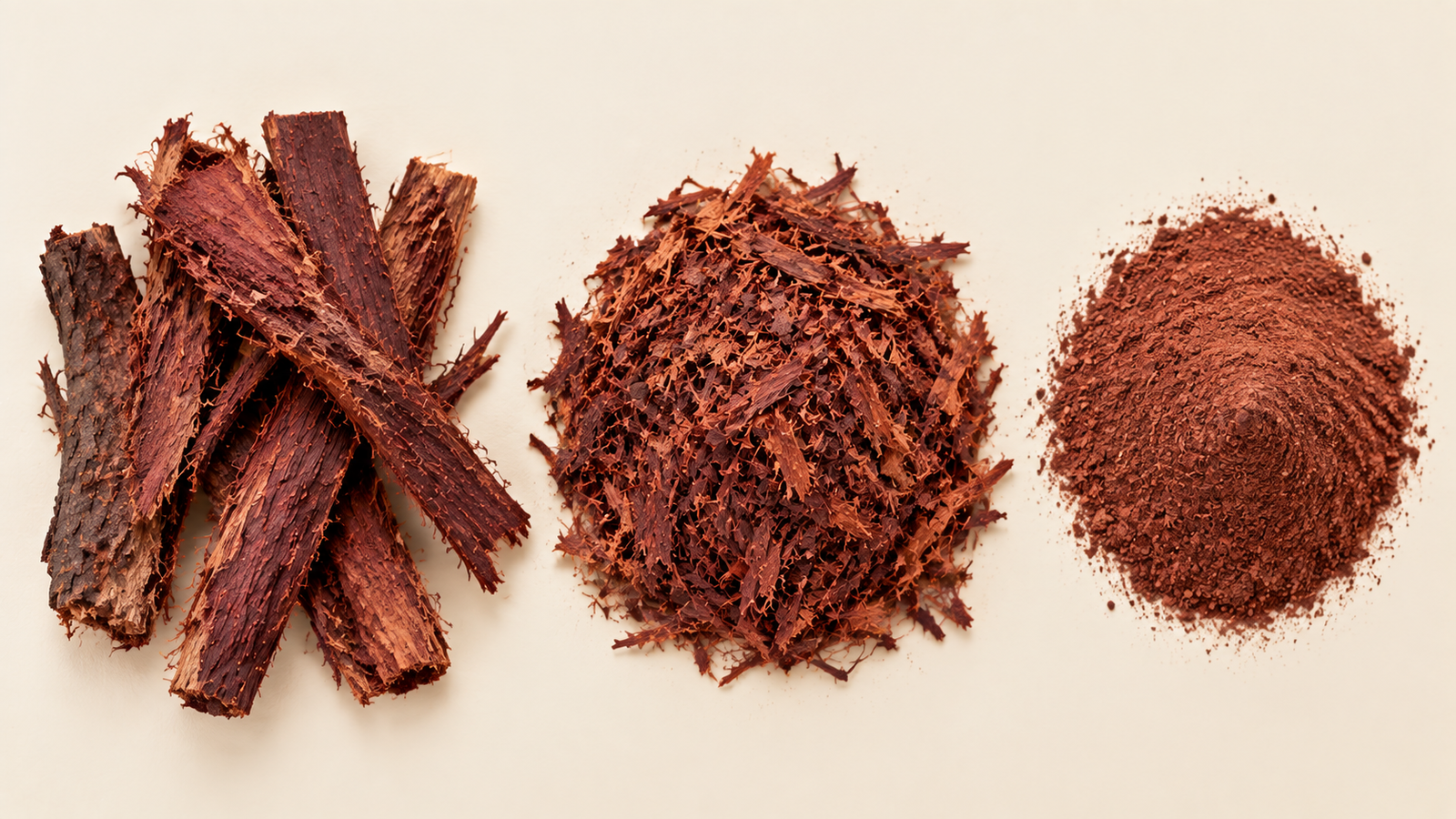
MHRB is sold in three primary physical formats. The right choice depends on your intended application, storage capacity, and how much processing you want to do yourself.
| Form | Description | Best For |
|---|---|---|
| Whole Root Bark | Minimally processed. Inner bark separated and dried but left in large pieces or strips. Retains visible structure, fibers, and natural color. | Long-term storage, visual inspection, specimen collections |
| Shredded Root Bark | Cut into small, uniform pieces. Easier to handle than whole bark, still retains fibrous structure. | Dye work, craft applications, easy portioning |
| Root Bark Powder | Finely milled to a uniform, consistent powder. Highest surface area; most compact to store. | Dye baths, precise measurement, research documentation |
Which Form Should You Choose?
- If you’re new to working with the material, start with shredded bark — it’s forgiving and easy to work with.
- If you’re doing dye work, powder gives you the fastest and most even extraction of color.
- If you’re building a botanical collection, whole bark preserves the most authentic visual structure and stores longest.
- If you’re short on storage space, powder is the most compact form per gram.
How to Identify Quality Mimosa Hostilis Root Bark
As with any botanical material, quality varies widely between suppliers. Here’s what to look for — and what should raise a red flag.
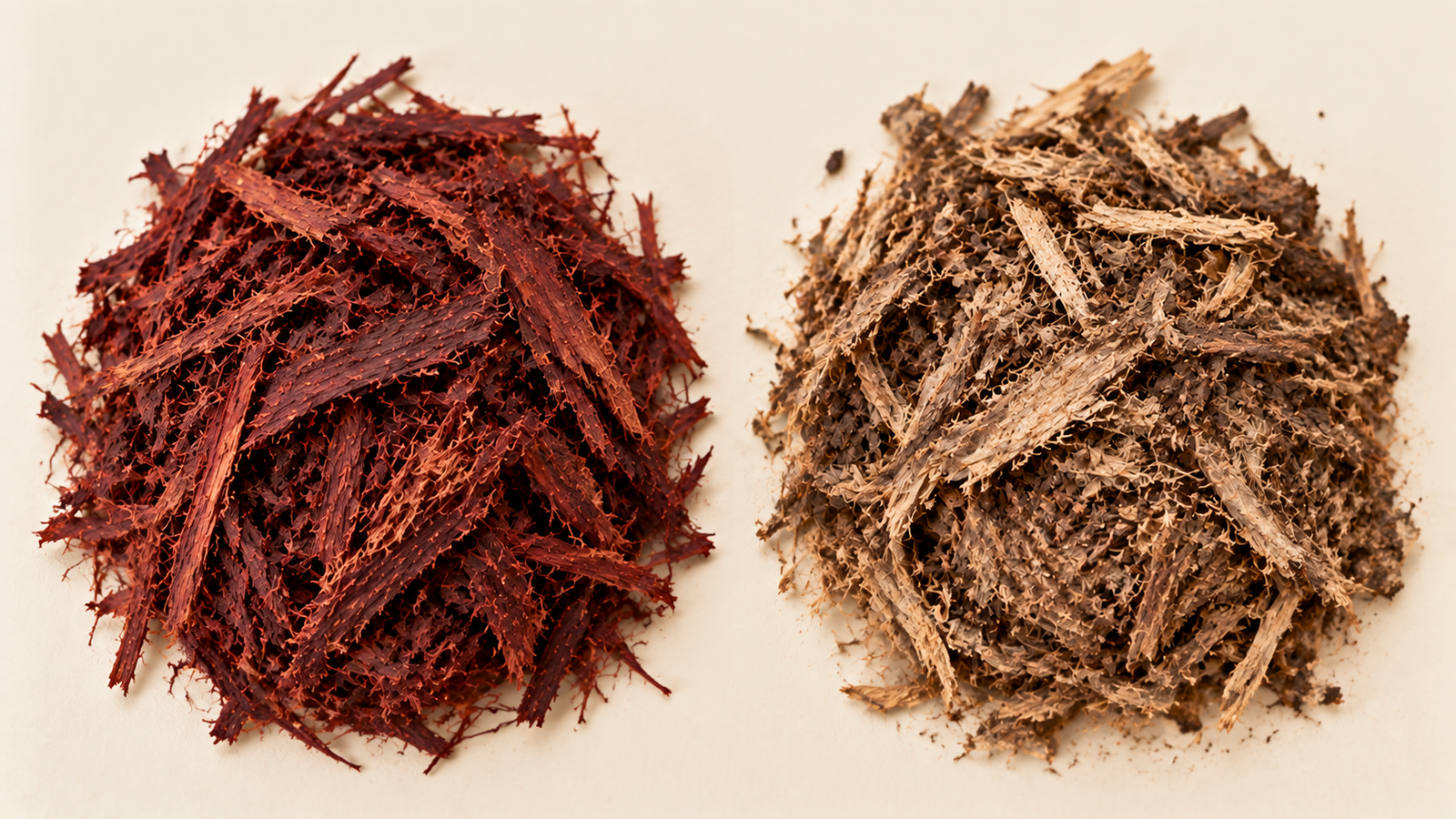
Positive Quality Indicators
- Deep, consistent coloration — the inner bark should show a rich reddish-brown to deep burgundy tone. Pale or washed-out material usually indicates outer bark contamination or poor processing.
- Fine, even texture (in powder form) — good powder is uniform throughout, with no large fibrous chunks or gritty particles.
- Visible fibrous structure (in whole and shredded forms) — you should be able to see the natural plant fibers clearly.
- Clean, earthy aroma — a mild, natural plant scent. Not musty, sour, or chemical.
- No visible contaminants — no sand, soil, twigs, or foreign plant material.
- Properly dried — should feel dry to the touch, not damp or clumping.
- Clear origin labeling — good suppliers state whether the material is Brazilian or Mexican, and provide batch information.
Red Flags
- Unnaturally bright or artificially uniform color (may indicate dyeing or treatment)
- Chemical, solvent, or plastic-like smell
- Powder that clumps together or feels damp
- Large amounts of fine dust or grit in whole or shredded material
- No origin information or vague sourcing claims
- Suspiciously low pricing compared to market rates
Storage Guidelines
Mimosa Hostilis Root Bark is a dried plant material, and like all dried botanicals, it degrades over time if not stored correctly. Proper storage protects color, texture, aroma, and overall usability.
- Keep it dry. Moisture is the single biggest threat. Store in an airtight container — glass jars with sealed lids or vacuum-sealed bags work best.
- Keep it dark. Direct sunlight fades natural pigments and accelerates degradation.
- Keep it cool. Room temperature is fine. Avoid hot attics, garages, or areas near appliances that generate heat.
- Add a desiccant if storing long-term. A food-grade silica gel packet inside the container helps control residual humidity.
- Label everything. Include the date you received the material and the origin so you can track quality over time.
Stored this way, dried Mimosa Hostilis Root Bark retains its color, aroma, and working properties for well over a year. Powder degrades slightly faster than whole or shredded bark because of its greater surface area — plan to use powder within 12 months for best results.
Explore Mimosa Hostilis Products
We carry Mimosa Hostilis Root Bark in multiple forms and both major regional origins. Each batch is labeled with its source and handled to preserve quality in transit.
Mexican MHRB — Whole Inner Root Bark
Intact inner bark strips sourced from cultivated Mexican trees. Best for archival storage, specimen collections, and buyers who prefer to process material themselves.
View Product →Mexican MHRB — Shredded
Uniformly shredded inner bark. A practical middle ground between whole bark and powder — easy to portion, retains visible structure.
View Product →Mexican MHRB — Powder
Finely milled inner bark powder. Ideal for dye baths, precise measurement, and research documentation.
View Product →Brazilian MHRB — Whole
Thick, fibrous whole inner bark from Brazilian sources. Known for deeper burgundy coloration and robust texture.
View Product →Brazilian MHRB — Shredded
Shredded Brazilian inner bark. Balances ease of handling with the distinct character of Brazilian material.
View Product →Brazilian MHRB — Powder
Finely ground Brazilian inner bark. Deep color, consistent texture, ready for dye and craft applications.
View Product →Browse the Full Mimosa Hostilis Collection
Every batch labeled by origin. Every order shipped discreetly and packaged to protect quality.
Shop Mimosa Hostilis Root BarkFrequently Asked Questions
What is Mimosa Hostilis Root Bark?
Mimosa Hostilis Root Bark (MHRB) is the dried inner bark of the roots of Mimosa tenuiflora, a leguminous tree native to Brazil and Mexico. It is used as a botanical specimen in research, natural dye work, craft applications, and collection archives.
What does MHRB mean?
MHRB is an abbreviation for Mimosa Hostilis Root Bark. It’s the standard shorthand used in botanical trade and research contexts.
Is Mimosa Hostilis the same as Mimosa tenuiflora?
Yes. Mimosa Hostilis is the older and more widely used name; Mimosa tenuiflora is the currently accepted scientific classification. They refer to the same species.
What is the difference between Brazilian and Mexican MHRB?
Brazilian Mimosa Hostilis (Jurema Preta) typically has thicker, more fibrous bark with a deeper burgundy color. Mexican Mimosa Hostilis (Tepezcohuite) tends to be lighter in color and more uniform in texture. Both are high quality — the choice comes down to the specific characteristics you’re looking for.
What forms does Mimosa Hostilis Root Bark come in?
Three main forms: whole root bark (large intact pieces, minimally processed), shredded root bark (small uniform pieces), and powder (finely milled). Each serves different applications.
What is the difference between root bark and trunk bark?
Root bark is the outer layer of a tree’s root system. It’s biochemically distinct from trunk or branch bark and typically contains higher concentrations of tannins, pigments, and other phytochemicals. Within the root, the inner bark is the most valued layer.
How should I store Mimosa Hostilis Root Bark?
Store it in a cool, dark, dry location in an airtight container. Add a food-grade desiccant packet for long-term storage. Properly stored, whole and shredded bark keeps for well over a year; powder is best used within 12 months.
How do I identify quality Mimosa Hostilis Root Bark?
Look for deep, consistent reddish-brown color, fine even texture (for powder), visible fibrous structure (for whole or shredded), clean earthy aroma, and no visible contaminants. Avoid material that is damp, clumping, chemically scented, or unnaturally colored.
Is Mimosa Hostilis Root Bark legal?
Legality varies by jurisdiction. In many countries the plant material itself is legal to possess for botanical purposes, but some jurisdictions restrict or prohibit it. Buyers are responsible for verifying the laws that apply where they live before purchasing or possessing this material.
Do you ship internationally?
We ship to destinations where Mimosa Hostilis Root Bark is legal to import and possess. It is the buyer’s responsibility to confirm that receiving this material is lawful in their jurisdiction.
